Valence and the Australian Curriculum (Years 7–10 chemistry)
Valence is a free chemistry card game. This page shows which Australian Curriculum Version 9.0 Chemical sciences content descriptions it supports, year by year, and where it does not fit.
About the game
Valence is a free chemistry card game for Android and iPhone. Each card is an element; students combine cards into real compounds to beat enemies whose weaknesses follow real chemistry. Ten acts each add one idea, and quiz rooms ask questions at a level the student picks (1,257 questions, each with an explanation and the common mistake to avoid). No ads, no chat, no purchases; students under 14 play without signing in.
What it looks like in the game
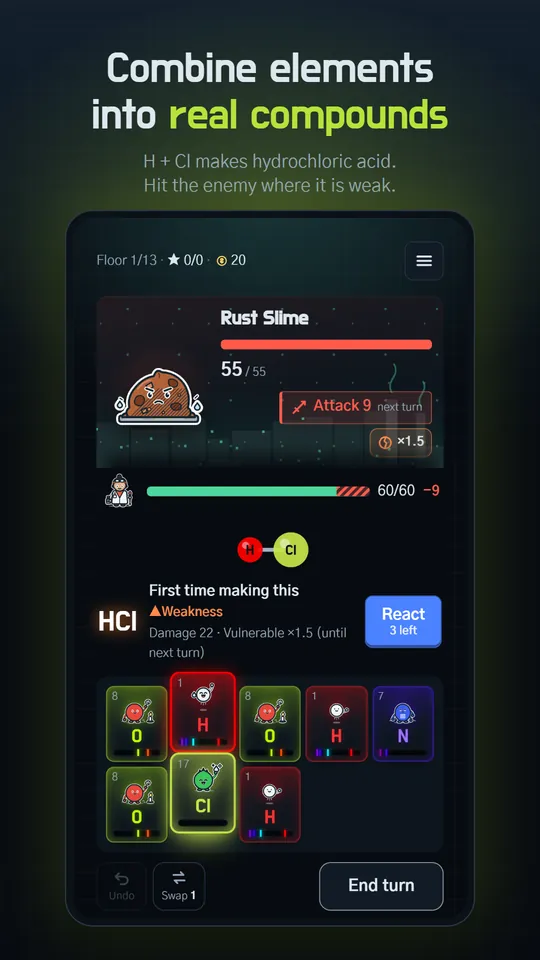
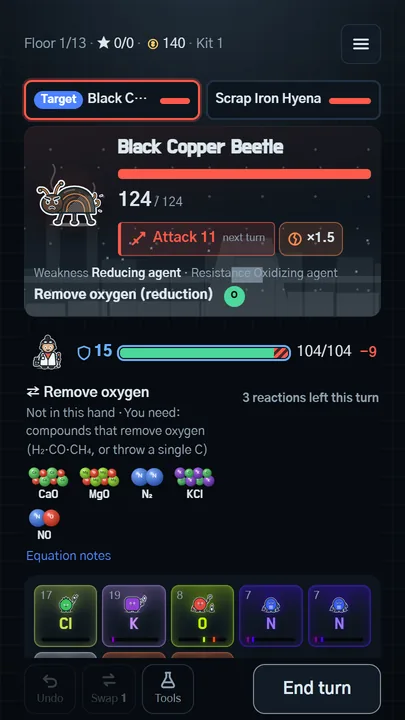
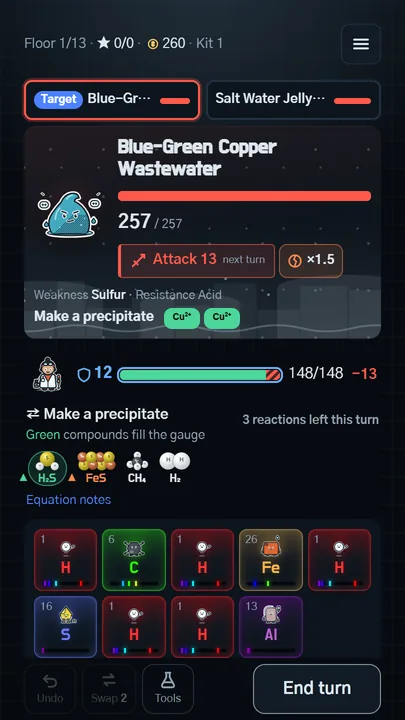
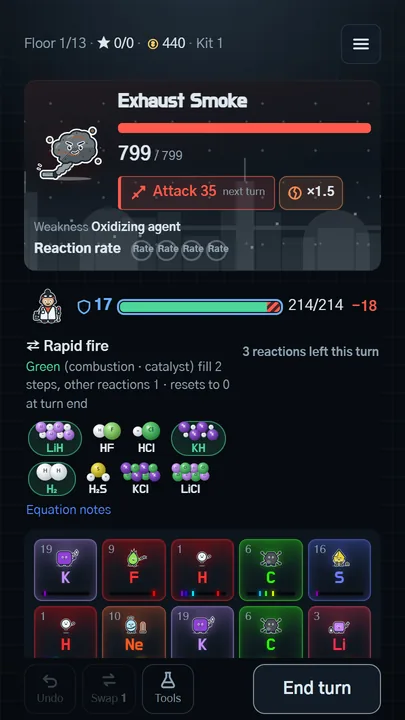
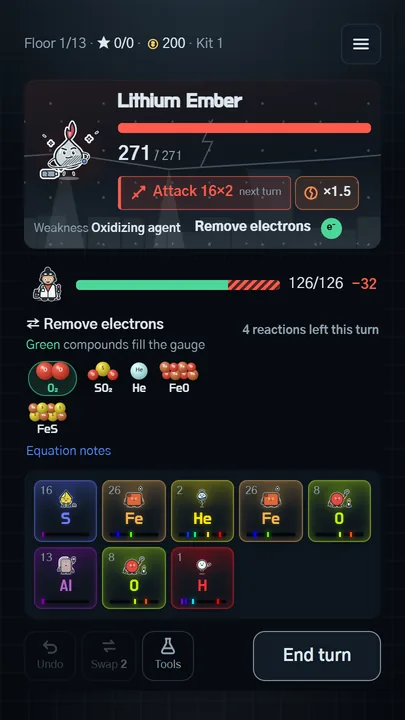
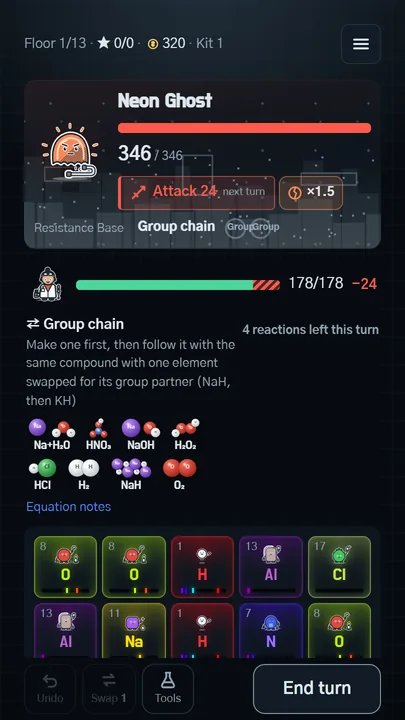
Years 7–10 Science: Chemical sciences
Australian Curriculum Version 9.0, Science Understanding, Chemical sciences sub-strand. Descriptions are paraphrased; follow the codes to the official wording.
| Year | Code | What students learn (paraphrased) | Where it appears in Valence | Fit |
|---|---|---|---|---|
| Year 7 | AC9S7U05 | Particle theory: how particles are arranged and move, and how that explains the properties of substances | Quiz level “Grade 7” (gases, changes of state). No game act. | Partial |
| Year 8 | AC9S8U06 | Classify matter as elements, compounds or mixtures; represent them with symbols, formulas and models | Act 1: building compounds from elements (H₂O, HCl, NaCl, CO₂, NH₃, CH₄); quiz level “Grade 8” (elements, atoms, ions) | Strong |
| Year 8 | AC9S8U07 | Physical and chemical change; signs of energy change in reactions | Reaction cards, including combustion; quiz level “Grade 9” (rules and energy of reactions) | Partial |
| Year 9 | AC9S9U06 | Atomic structure (protons, neutrons, electrons) and natural radioactive decay | Act 4: electron shells (Li, F); Act 10: nuclear reactions (U, Pb). The history of atomic models is not in the game. | Partial |
| Year 9 | AC9S9U07 | Atoms rearrange in chemical reactions; word and simple balanced equations | Act 1: building compounds from elements (H₂O, HCl, NaCl, CO₂, NH₃, CH₄); quiz level “Grade 9”. Conservation of mass is not a game mechanic. | Partial |
| Year 10 | AC9S10U06 | How atomic structure relates to the organisation of the periodic table | Act 4: electron shells (Li, F); Act 6: position in the periodic table; Act 7: types of chemical bonds; quiz level “Grade 10” | Strong |
| Year 10 | AC9S10U07 | Patterns in synthesis, decomposition and displacement reactions (including neutralisation and precipitation); factors that affect reaction rate | Act 1: building compounds from elements (H₂O, HCl, NaCl, CO₂, NH₃, CH₄); Act 2: neutralization and pH; Act 3: oxidation and reduction (Cu, Zn); Act 5: precipitation reactions (Ag⁺, Ba²⁺); Act 8: reaction rate and catalysts (MnO₂, Pt) | Strong |
Best fit: Year 10 chemical reactions (AC9S10U07). The official elaborations for this code mention forming water and sodium chloride, metals reacting with oxygen, neutralisation, precipitation and catalysts, and each of these is a mechanic in Valence.
Senior secondary Chemistry
The Australian Curriculum senior Chemistry units, which states deliver through their own syllabuses (for example QCE, WACE, HSC, VCE and SACE).
| Unit | Where it appears in Valence | Fit |
|---|---|---|
| Unit 1: Chemical fundamentals: structure, properties and reactions | Act 4: electron shells (Li, F); Act 6: position in the periodic table; Act 7: types of chemical bonds; quiz level “Chemistry I” (moles, atomic structure, bonds) | Partial |
| Unit 2: Molecular interactions and reactions | Act 8: reaction rate and catalysts (MnO₂, Pt); quiz level “Chemistry II” (gases, solutions, rates, enthalpy) | Partial |
| Unit 3: Equilibrium, acids and redox reactions | Act 9: chemical equilibrium (ammonia); Act 2: neutralization and pH; Act 3: oxidation and reduction (Cu, Zn); equilibrium, redox and electrochemistry quiz questions | Strong |
| Unit 4: Structure, synthesis and design | Not covered (organic chemistry) | None |
What Valence does not cover
- Separating mixtures (Year 7)
- The history of atomic models (Year 9)
- Demonstrating conservation of mass (Year 9)
- Organic chemistry (senior Unit 4)
A Year 10 example
- Before the reactions unit, students play Act 1 and note each compound they make and its formula.
- During the unit, Act 2 (neutralisation), Act 3 (displacement with Cu and Zn) and Act 5 (precipitation) each give a reaction type to classify.
- For rates, Act 8 asks students to fill a gauge within one turn, and catalysts count double. Ask why a catalyst speeds a reaction without being used up.
- Set the quiz level to “Grade 10” for revision; wrong answers return in the review notebook.
Common questions
- Is Valence aligned to the Australian Curriculum Version 9.0?
- We mapped Valence to the Version 9.0 Chemical sciences content descriptions for Years 7–10. The strongest connections are AC9S8U06 (elements, compounds, formulas), AC9S10U06 (atomic structure and the periodic table) and AC9S10U07 (reaction types and reaction rates). Valence is not endorsed by ACARA.
- Which year level is Valence best for in Australia?
- Years 8 to 10, with the best fit in Year 10 chemical reactions. Quiz levels also reach senior Chemistry topics such as equilibrium, acids and redox (Unit 3).
- Is Valence free for Australian schools?
- Yes. It is free on Android and iPhone in Australia, with no ads, chat or purchases. Students under 14 play without an account and send no data.
- Does Valence work without Wi-Fi?
- Yes. After installing, it plays offline.
More
Other curriculum pages: New Zealand · Canada (Ontario and BC). How Valence works in class and how student privacy is handled: Valence for teachers. If you think we mapped something wrong, please tell us at valence@adriven.co.
Curriculum content: © Australian Curriculum, Assessment and Reporting Authority (ACARA) 2010 to present, unless otherwise indicated. This material was downloaded from the Australian Curriculum website (www.australiancurriculum.edu.au) (accessed 9 November 2026) and was modified. The material is licensed under CC BY 4.0. ACARA does not endorse any product that uses the Australian Curriculum or make any representations as to the quality of such products. Any product that uses material published on that website should not be taken to be affiliated with ACARA or have the sponsorship or approval of ACARA.