Valence and the New Zealand Curriculum (Years 9–10 Science and NCEA chemistry)
Valence is a free chemistry card game. This page shows which parts of the refreshed Years 9–10 Science curriculum and which NCEA chemistry standards it supports, and where it does not fit.
About the game
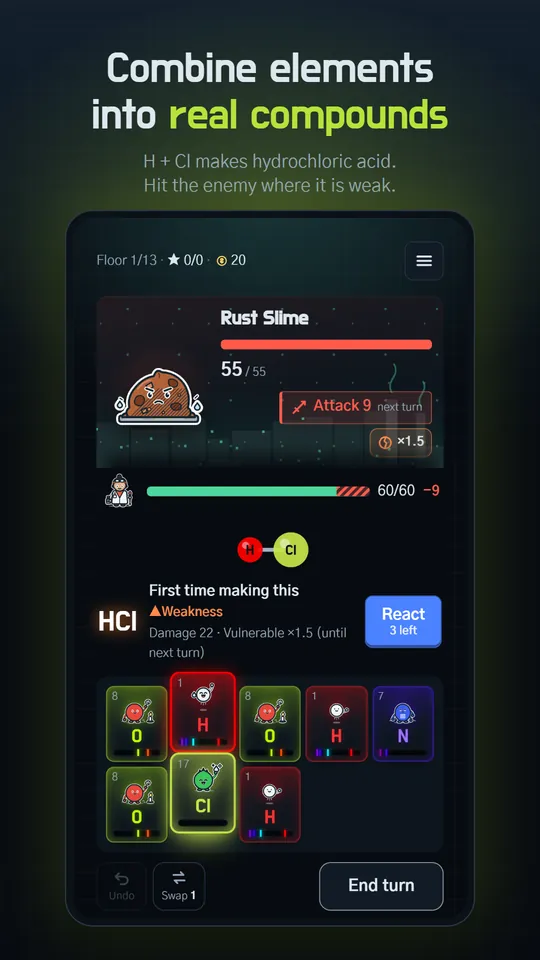
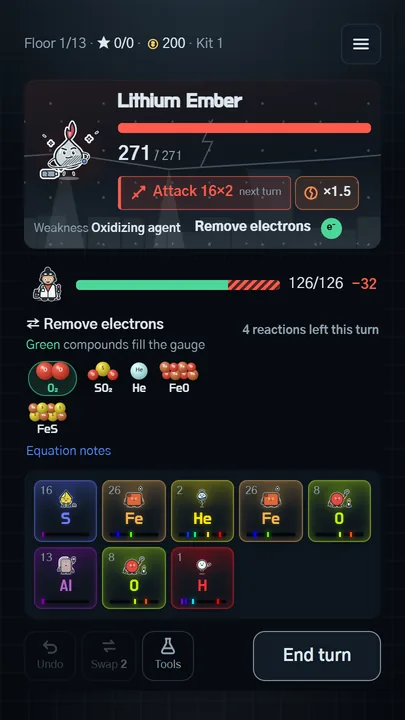
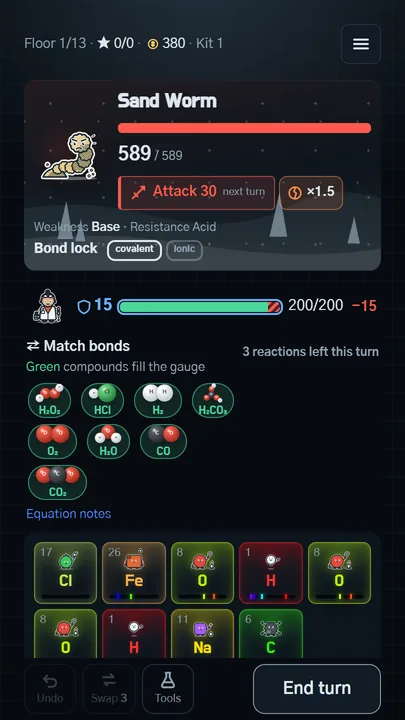
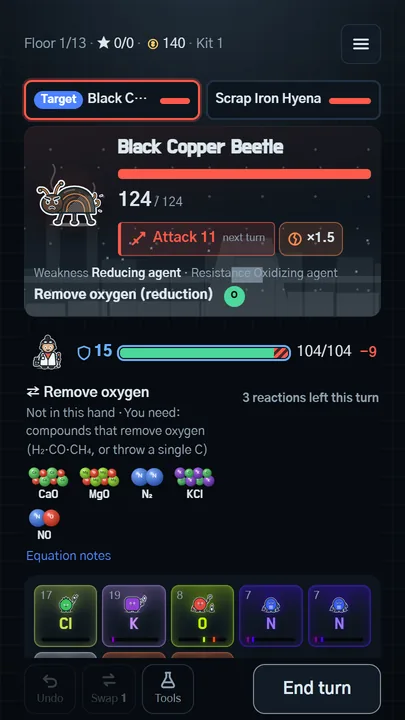
Valence is a free chemistry card game for Android and iPhone. Each card is an element; students combine cards into real compounds to beat enemies whose weaknesses follow real chemistry. Ten acts each add one idea, and quiz rooms ask questions at a level the student picks (1,257 questions, each with an explanation and the common mistake to avoid). No ads, no chat, no purchases; students under 14 play without signing in.
What it looks like in the game
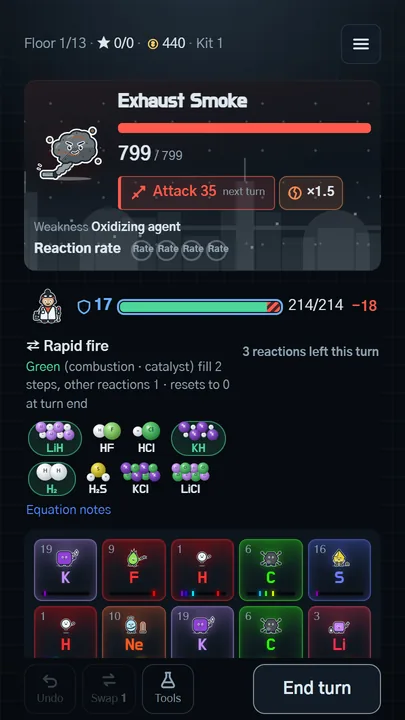
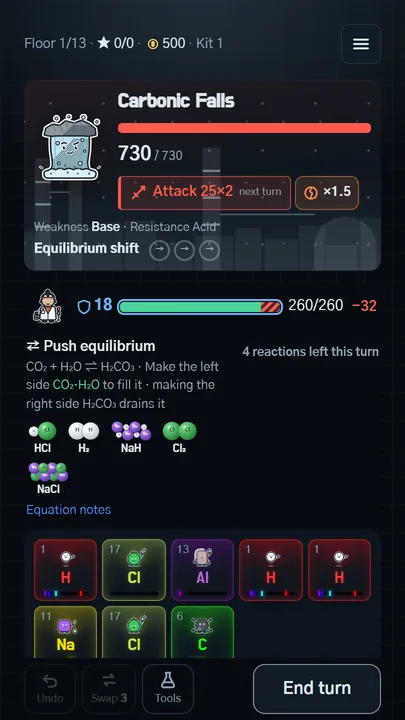
Years 9–10 Science (Phase 4)
The refreshed New Zealand Curriculum for Science, Years 0–10, is part of the National Curriculum Statement 2026. Schools begin using it in 2027, and Years 9–10 are to be in place by the end of 2027. Chemistry sits in the Physical Science strand. The statements below are paraphrased; check the final wording on Tāhūrangi.
| Year | What students learn (paraphrased) | Where it appears in Valence | Fit |
|---|---|---|---|
| Year 9 | All matter is made of atoms of elements; element names and symbols; metals and non-metals | Quiz questions on elements, atoms and ions | Strong |
| Year 9 | Patterns within groups of the periodic table | Act 6: position in the periodic table | Strong |
| Year 9 | Elements, molecules, compounds and mixtures; reading chemical formulas such as H₂O | Act 1: building compounds from elements (H₂O, HCl, NaCl, CO₂, NH₃, CH₄) | Strong |
| Year 9 | Reactions rearrange atoms into new substances; word equations | Act 1: building compounds from elements (H₂O, HCl, NaCl, CO₂, NH₃, CH₄); quiz questions on rules of reactions | Strong |
| Year 9 | Everyday combustion, acid–base and oxidation–reduction reactions | Act 2: neutralization and pH; Act 3: oxidation and reduction (Cu, Zn) | Strong |
| Year 10 | Protons, neutrons and electrons; electron arrangement in shells | Act 4: electron shells (Li, F) | Strong |
| Year 10 | Ions and their charges; ionic compounds and molecules formed by transferring or sharing electrons | Act 1: building compounds from elements (H₂O, HCl, NaCl, CO₂, NH₃, CH₄) (NaCl); Act 5: precipitation reactions (Ag⁺, Ba²⁺); Act 7: types of chemical bonds | Strong |
| Year 10 | Word and balanced equations for acid–base, combustion and displacement reactions | Act 1: building compounds from elements (H₂O, HCl, NaCl, CO₂, NH₃, CH₄); Act 2: neutralization and pH; Act 3: oxidation and reduction (Cu, Zn) | Strong |
| Year 10 | Acids and bases, pH and indicators; neutralisation | Act 2: neutralization and pH | Strong |
| Year 10 | Reactivity of metals | Act 3: oxidation and reduction (Cu, Zn) | Strong |
| Year 10 | Factors that affect reaction rate | Act 8: reaction rate and catalysts (MnO₂, Pt). Catalysts go a little beyond Year 10. | Strong |
| Years 7–8 | Particle model of solids, liquids and gases; changes of state | Quiz questions on gases and changes of state. No game act. | Partial |
Best fit: Year 10. Atoms, shells, ions, ionic and covalent compounds, acids and bases, metal reactivity and reaction rates each have an act of their own in Valence.
NCEA chemistry standards (2026)
Valence reinforces the concepts behind these standards. NCEA is assessed through written explanation and investigation, so use the game alongside teaching, not as assessment preparation on its own.
| Subject | Standard | Title (shortened) | Where it appears in Valence | Fit |
|---|---|---|---|---|
| Level 1 Chemistry and Biology | 92021 | Chemical reactions in context (6 credits, internal) | Act 1: building compounds from elements (H₂O, HCl, NaCl, CO₂, NH₃, CH₄); Act 2: neutralization and pH; Act 3: oxidation and reduction (Cu, Zn); Act 5: precipitation reactions (Ag⁺, Ba²⁺); Act 8: reaction rate and catalysts (MnO₂, Pt) | Strong |
| Level 1 Chemistry and Biology | 92023 | Physical properties of materials and their use (4 credits, external) | Act 7: types of chemical bonds | Partial |
| Level 2 Chemistry | 91164 | Bonding, structure, properties and energy changes (5 credits, external) | Act 4: electron shells (Li, F); Act 7: types of chemical bonds; enthalpy quiz questions | Strong |
| Level 2 Chemistry | 91166 | Chemical reactivity (4 credits, external) | Act 2: neutralization and pH; Act 8: reaction rate and catalysts (MnO₂, Pt); Act 9: chemical equilibrium (ammonia) | Strong |
| Level 2 Chemistry | 91167 | Oxidation–reduction (3 credits, internal) | Act 3: oxidation and reduction (Cu, Zn) (introductory) | Partial |
| Level 2 Chemistry | 91911 | Qualitative analysis of chemical species (3 credits, internal) | Act 5: precipitation reactions (Ag⁺, Ba²⁺) (which ions form precipitates) | Partial |
| Level 3 Chemistry | 91392 | Equilibrium principles in aqueous systems (5 credits, external) | Act 9: chemical equilibrium (ammonia); Act 2: neutralization and pH; solutions and equilibrium quiz questions | Partial |
| Level 3 Chemistry | 91393 | Oxidation–reduction processes (3 credits, internal) | Act 3: oxidation and reduction (Cu, Zn); electrochemistry quiz questions | Partial |
| Level 2 Physics | 91172 | Atomic and nuclear physics (3 credits, internal) | Act 10: nuclear reactions (U, Pb) | Partial |
NCEA is changing. The Government has announced that NCEA Level 1 is removed from 2028, with new qualifications for Year 12 (2029) and Year 13 (2030). The standards above are current for 2026. We will update this page as the new senior Chemistry curriculum is finalised.
About the quiz level names
Valence names its quiz levels with North American grade numbers. New Zealand year numbers run one higher, so use this guide:
| Quiz level in the game | Topics | Closest NZ level |
|---|---|---|
| Grade 7 | Gases, changes of state | Year 8 |
| Grade 8 | Elements, atoms and ions, properties of matter | Year 9 |
| Grade 9 | Rules and energy of chemical reactions | Year 10 |
| Grade 10 | Periodic table, bonds, redox, acids and bases | Years 10–11 |
| Chemistry I | Moles, atomic structure, bonds, equilibrium, redox | NCEA Level 2 |
| Chemistry II | Gases, solutions, enthalpy, equilibrium, rates, electrochemistry | NCEA Levels 2–3 |
What Valence does not cover
- Mixtures, dissolving and separation (Years 7–8)
- Organic chemistry (NCEA Level 2 91165, Level 3 91391)
- Spectroscopy and quantitative analysis
Common questions
- Does Valence fit the new NZ Science curriculum?
- Yes, especially Year 10 in Phase 4: atoms and electron shells, ions, ionic and covalent compounds, acids and bases, metal reactivity and reaction rates. Year 9 topics such as element symbols, periodic table groups and chemical formulas are also covered.
- Which NCEA standards does Valence support?
- Mainly Level 1 Chemistry and Biology 92021 (chemical reactions in context) and Level 2 Chemistry 91164 (bonding) and 91166 (reactivity). It reinforces concepts; it does not replace written assessment practice.
- Is Valence free in New Zealand?
- Yes. It is free on Android and iPhone in New Zealand, with no ads, chat or purchases. Students under 14 play without an account and send no data.
- Does Valence use NZ year levels?
- The game names quiz levels with North American grades. Grade 8 in the game is closest to NZ Year 9, and Grade 9 to Year 10. A conversion table is on this page.
More
Other curriculum pages: Australia · Canada (Ontario and BC). How Valence works in class and how student privacy is handled: Valence for teachers. If you think we mapped something wrong, please tell us at valence@adriven.co.
Sources: Ministry of Education, New Zealand Curriculum, Science Phases 1–4 (Tāhūrangi); NZQA achievement standards, 2026. Valence is not endorsed by the Ministry of Education or NZQA. Science Phase 4 (Years 9–10) · NZQA Chemistry