Valence and the Ontario and British Columbia curriculum (chemistry)
Valence is a free chemistry card game. This page shows which Ontario expectations and BC curriculum content it supports, course by course, and where it does not fit.
About the game
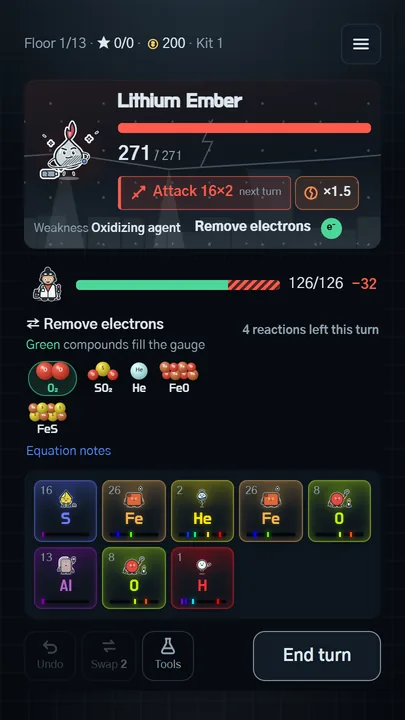
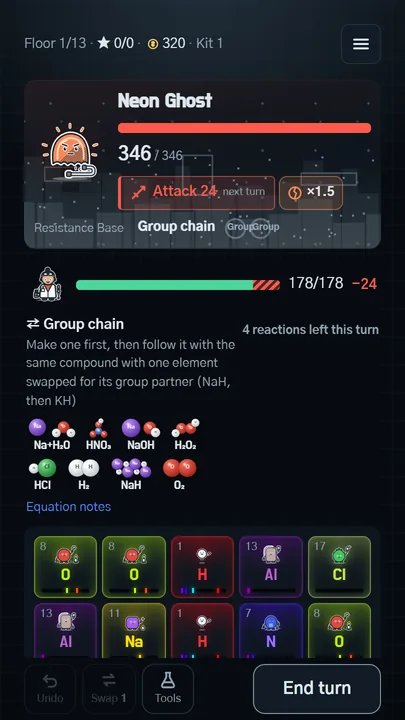
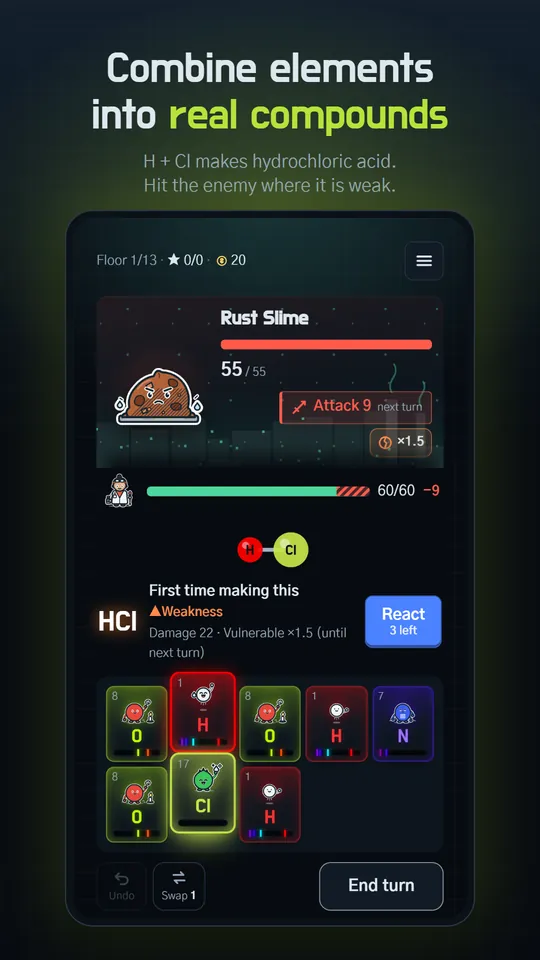
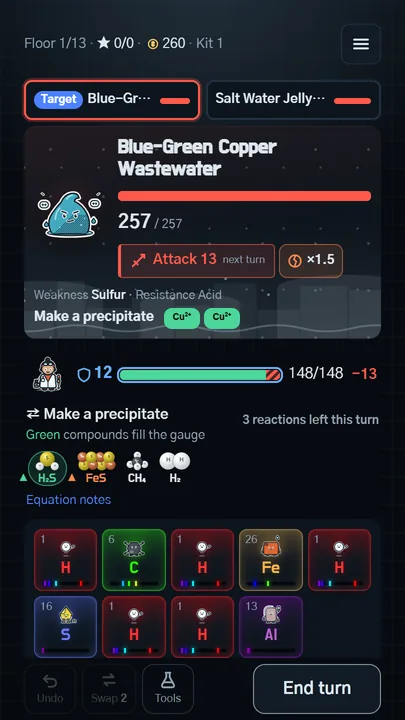
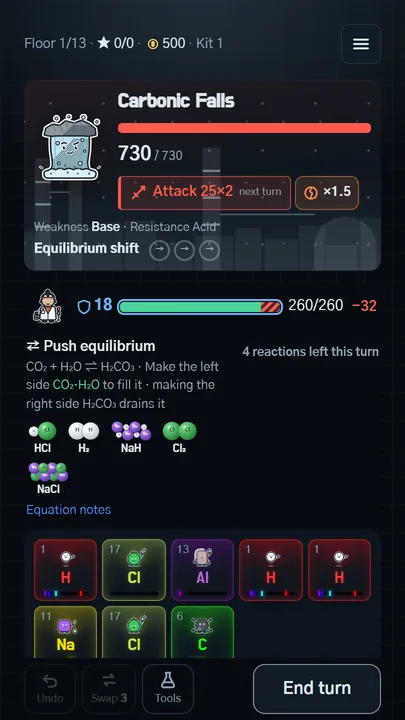
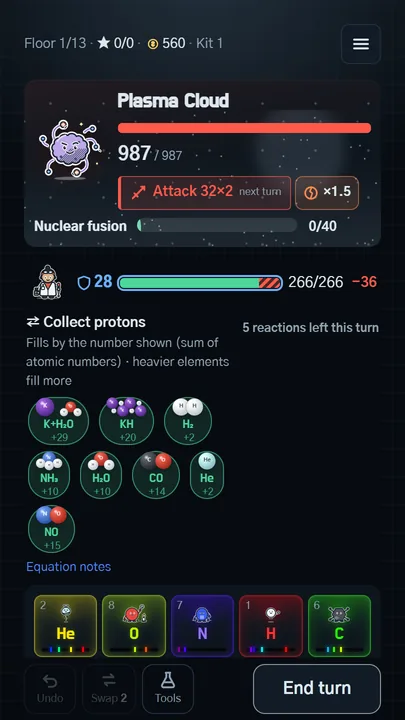
Valence is a free chemistry card game for Android and iPhone. Each card is an element; students combine cards into real compounds to beat enemies whose weaknesses follow real chemistry. Ten acts each add one idea, and quiz rooms ask questions at a level the student picks (1,257 questions, each with an explanation and the common mistake to avoid). No ads, no chat, no purchases; students under 14 play without signing in.
What it looks like in the game
Ontario
Science and Technology, Grades 1–8 (2022); Grade 9 Science SNC1W (2022); Grades 10–12 Science (2008). Expectation numbers are from the Ontario curriculum website; descriptions are our own paraphrases.
| Course | Expectations | What students learn (paraphrased) | Where it appears in Valence | Fit |
|---|---|---|---|---|
| Grade 7 Science and Technology | C2.1, C2.8 | Particle theory; pure substances are elements and compounds made of atoms | Act 1: building compounds from elements (H₂O, HCl, NaCl, CO₂, NH₃, CH₄); quiz levels “Grade 7” and “Grade 8” | Partial |
| Grade 9 SNC1W | C2.3, C2.4 | Subatomic particles and Bohr–Rutherford diagrams; atomic structure and the periodic table | Act 4: electron shells (Li, F); Act 6: position in the periodic table | Strong |
| Grade 9 SNC1W | C2.5 | Periodic table organization and patterns in element properties | Act 6: position in the periodic table | Strong |
| Grade 9 SNC1W | C2.7 | Structure of simple compounds and their chemical formulas | Act 1: building compounds from elements (H₂O, HCl, NaCl, CO₂, NH₃, CH₄) | Strong |
| Grade 10 SNC2D | C3.1, C3.8 | Formulas and names of compounds such as NaCl, CO₂, H₂O, NH₃ and HCl | Act 1: building compounds from elements (H₂O, HCl, NaCl, CO₂, NH₃, CH₄) | Strong |
| Grade 10 SNC2D | C2.6, C3.6, C3.7 | Acids, bases, the pH scale and neutralization | Act 2: neutralization and pH | Strong |
| Grade 10 SNC2D | C2.3, C3.5 | Synthesis, decomposition and displacement reactions | Act 1: building compounds from elements (H₂O, HCl, NaCl, CO₂, NH₃, CH₄); Act 3: oxidation and reduction (Cu, Zn) (as displacement) | Partial |
| Grade 10 SNC2D | C2.5, C3.3 | Evidence of chemical change, including a precipitate | Act 5: precipitation reactions (Ag⁺, Ba²⁺) | Partial |
| Grade 10 SNC2P | C3.2, C3.4, C3.5 | Formulas of simple compounds; neutralization; pH | Act 1: building compounds from elements (H₂O, HCl, NaCl, CO₂, NH₃, CH₄); Act 2: neutralization and pH | Strong |
| Grade 11 SCH3U | B3.3, B3.4, B3.5 | Periodic trends; how ionic and covalent bonds form; properties of ionic and molecular compounds | Act 6: position in the periodic table; Act 7: types of chemical bonds | Strong |
| Grade 11 SCH3U | C2.6, E2.5, E3.4 | Double displacement; precipitates and solubility | Act 5: precipitation reactions (Ag⁺, Ba²⁺) | Strong |
| Grade 11 SCH3U | C2.9, E3.5, E3.6 | Neutralization; acid–base theory; strong and weak acids | Act 2: neutralization and pH | Strong |
| Grade 11 SCH3U | D3.2 | The mole and molar mass | Quiz level “Chemistry I” | Partial |
| Grade 12 SCH4U | D2.8, D3.5 | Collision theory and factors that affect rate, including catalysts | Act 8: reaction rate and catalysts (MnO₂, Pt) | Strong |
| Grade 12 SCH4U | E3.1–E3.3 | Dynamic equilibrium and Le Châtelier’s principle | Act 9: chemical equilibrium (ammonia) | Strong |
| Grade 12 SCH4U | F3.1 | Oxidation and reduction as electron transfer | Act 3: oxidation and reduction (Cu, Zn); electrochemistry quiz questions | Strong |
| Grade 12 SCH4U | C2.5, D3.1 | Types of solids including metallic; energy of nuclear reactions | Act 7: types of chemical bonds; Act 10: nuclear reactions (U, Pb) | Partial |
Best fit: SNC1W chemistry (Bohr–Rutherford diagrams, the periodic table, formulas) and SNC2D chemical reactions, where the compound list in C3.8 is nearly the same as the compounds students build in Act 1. Ontario Grade 8 (Fluids) has no matching act.
British Columbia
BC curriculum: Science 7–10, Chemistry 11 and Chemistry 12. Big ideas and content are paraphrased.
| Course | What students learn (paraphrased) | Where it appears in Valence | Fit |
|---|---|---|---|
| Science 7 | Elements and compounds are pure substances; chemical change rearranges atoms | Act 1: building compounds from elements (H₂O, HCl, NaCl, CO₂, NH₃, CH₄) | Strong |
| Science 8 | Kinetic molecular theory; atomic theory and models | Quiz levels “Grade 7” (gases, changes of state) and “Grade 8” (atoms) | Partial |
| Science 9 | Electron arrangement shapes chemical nature; the periodic table; ionic and covalent compounds; names and formulas | Act 1: building compounds from elements (H₂O, HCl, NaCl, CO₂, NH₃, CH₄); Act 4: electron shells (Li, F); Act 6: position in the periodic table; Act 7: types of chemical bonds | Strong |
| Science 10 | Reaction types including combustion, single and double replacement and neutralization; acid–base chemistry; corrosion | Act 2: neutralization and pH; Act 3: oxidation and reduction (Cu, Zn); Act 5: precipitation reactions (Ag⁺, Ba²⁺) | Strong |
| Science 10 | Nuclear energy: fission and fusion | Act 10: nuclear reactions (U, Pb) | Strong |
| Chemistry 11 | The mole; bonding and electronegativity; solubility and mixing ionic solutions | Act 5: precipitation reactions (Ag⁺, Ba²⁺); Act 7: types of chemical bonds; quiz level “Chemistry I” | Partial |
| Chemistry 12 | Reaction rates and catalysts; dynamic equilibrium; acid and base strength; oxidation and reduction | Act 2: neutralization and pH; Act 3: oxidation and reduction (Cu, Zn); Act 8: reaction rate and catalysts (MnO₂, Pt); Act 9: chemical equilibrium (ammonia) | Strong |
Best fit: Science 9, where electron arrangement, the periodic table, and ionic and covalent compounds are the core of the course, and Science 10, where nuclear fission and fusion are content items alongside reaction types.
About the quiz level names
Valence quiz levels “Grade 7” to “Grade 10” match Canadian grade numbers by age. “Chemistry I” is closest to Grade 11 chemistry (SCH3U, Chemistry 11) and “Chemistry II” to Grade 12 (SCH4U, Chemistry 12).
What Valence does not cover
- Mixtures, solubility and separation (Ontario Grade 7)
- Fluids and density (Ontario Grade 8)
- Organic chemistry (SCH4U strand B, Chemistry 11)
- Quantum-mechanical electron configuration with subshells
We have mapped Ontario and British Columbia first. Other provinces and territories follow later.
Common questions
- Does Valence fit the Ontario SNC1W chemistry strand?
- Yes. Act 4 (Bohr-style electron shells), Act 6 (periodic table groups) and Act 1 (formulas of simple compounds) connect to SNC1W expectations C2.3, C2.4, C2.5 and C2.7.
- Can Valence be used for SNC2D chemical reactions?
- Yes. Act 1 covers formulas such as NaCl, CO₂, H₂O, NH₃ and HCl (C3.1, C3.8), Act 2 covers acids, bases, pH and neutralization (C2.6, C3.6, C3.7), and Acts 3 and 5 add displacement and precipitates.
- Does Valence fit BC Science 9 and Science 10?
- Yes. Science 9 electron arrangement, the periodic table and ionic and covalent compounds match Acts 1, 4, 6 and 7. Science 10 reaction types, acid–base chemistry and nuclear fission and fusion match Acts 2, 3, 5 and 10.
- Is Valence free in Canada?
- Yes. It is free on Android and iPhone in Canada, in English, with no ads, chat or purchases. Students under 14 play without an account and send no data.
More
Other curriculum pages: Australia · New Zealand. How Valence works in class and how student privacy is handled: Valence for teachers. If you think we mapped something wrong, please tell us at valence@adriven.co.
Sources: Ontario Ministry of Education curriculum website (dcp.edu.gov.on.ca), © King’s Printer for Ontario; BC Ministry of Education and Child Care (curriculum.gov.bc.ca), © Province of British Columbia. Expectation numbers are cited and descriptions paraphrased. Valence is not endorsed by either ministry.