Valence for teachers
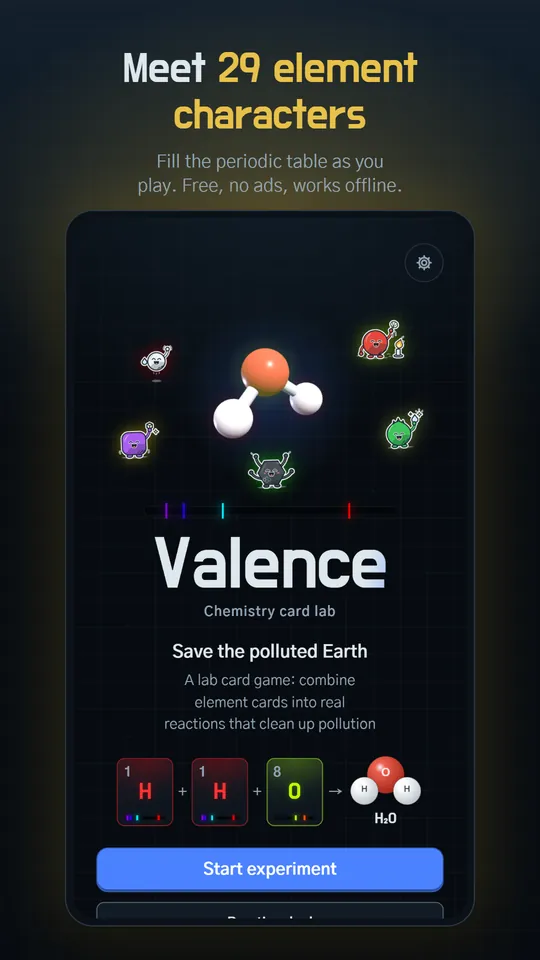
Valence is a free chemistry card game for Grades 7 to 12, on Android and iPhone. Students combine element cards into real compounds to beat enemies, and every new act adds a real chemistry idea.
Available now in Canada, Australia and New Zealand, in English. Free, with no ads, no chat and no in-app purchases.
How it plays
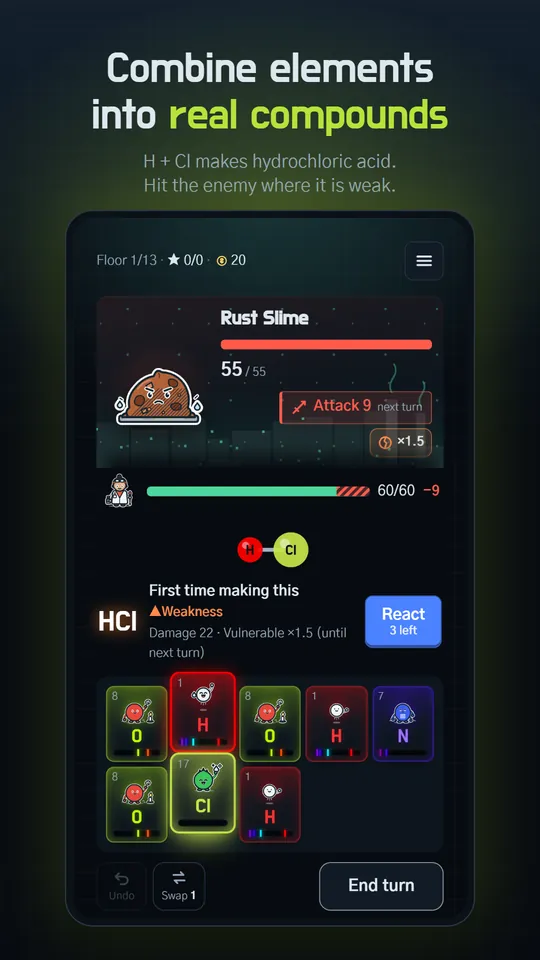
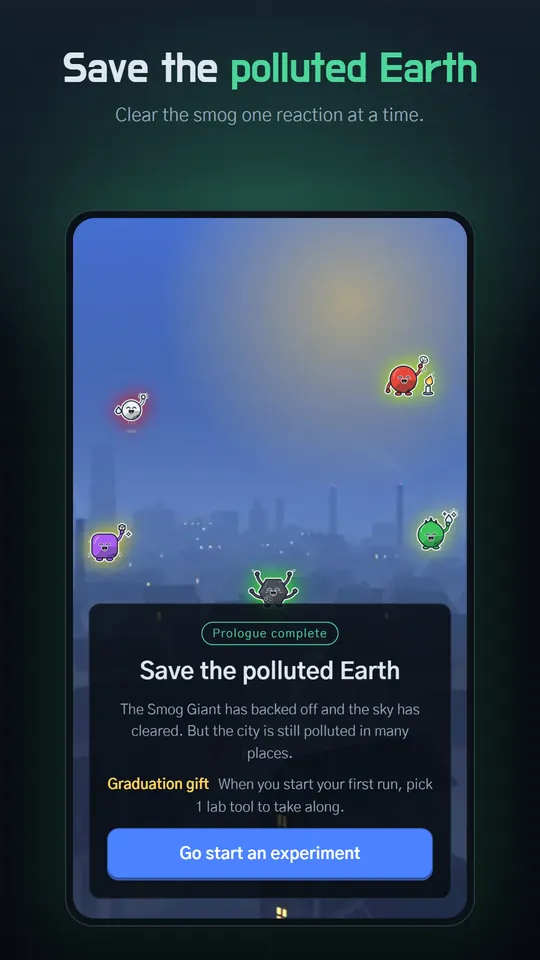
Each card is an element. Students pick cards that make a real compound: H + H + O makes water, H + Cl makes hydrochloric acid. Enemies have chemical weaknesses and resistances, so each fight is a small puzzle about which reaction to build. A short prologue teaches the controls before the first act.
What students practise
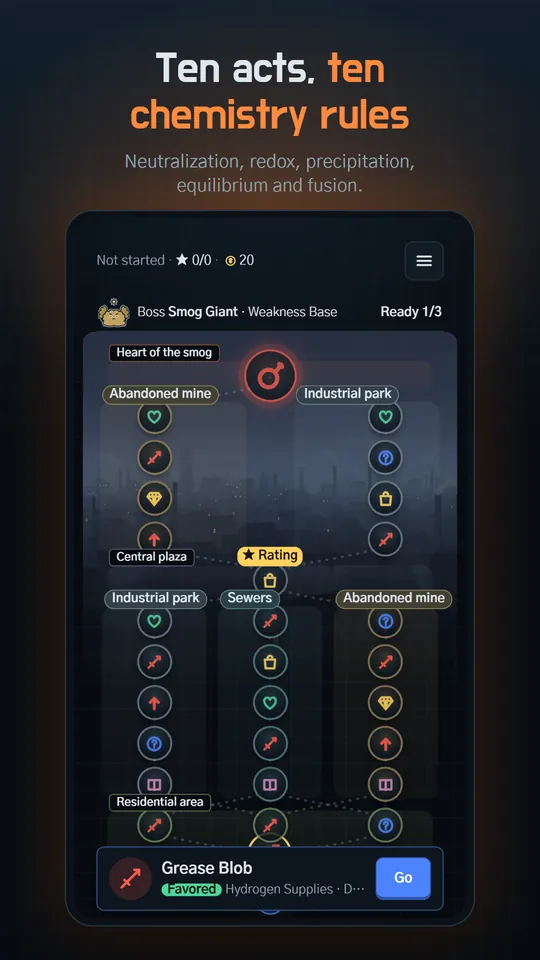
| Act | New idea | New elements |
|---|---|---|
| 1 | Building compounds from elements | H, O, C, N, Na, Cl |
| 2 | Neutralization and pH | Mg, Ca |
| 3 | Oxidation and reduction | Cu, Zn |
| 4 | Electron shells | Li, F |
| 5 | Precipitation reactions | Ag, Ba |
| 6 | Position in the periodic table | Br, Ne |
| 7 | Types of chemical bonds | Si, P |
| 8 | Reaction rate and catalysts | Mn, Pt |
| 9 | Chemical equilibrium | I, Co |
| 10 | Nuclear reactions | U, Pb |
Quiz questions
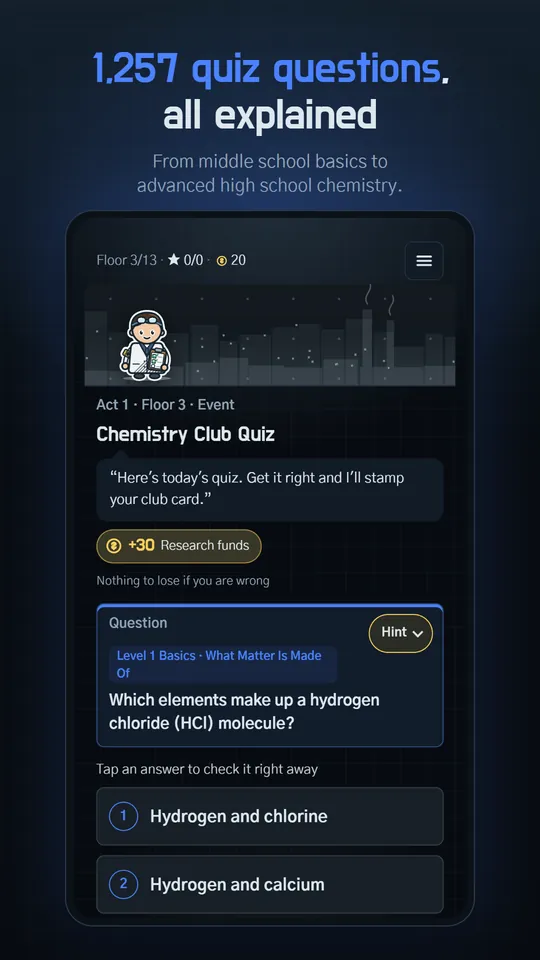
Quiz rooms appear during each run. There are 1,257 questions in six levels. Students choose a level once and can change it in Settings. Each question has an explanation and a note on the common mistake to avoid. Wrong answers go into a review notebook and come back later until the student gets them right.
| Level | Topics |
|---|---|
| Grade 7 | Properties of gases, changes of state |
| Grade 8 | Elements, atoms and ions, properties of matter |
| Grade 9 | Rules and energy of chemical reactions |
| Grade 10 | Periodic table, chemical bonds, oxidation and reduction, acids and bases |
| Chemistry I | Moles, atomic structure, chemical bonds, equilibrium and redox |
| Chemistry II | Gases and solutions, enthalpy and equilibrium, reaction rates, electrochemistry |
The levels follow a typical Grade 7 to senior chemistry sequence. Your local curriculum may order topics differently.
Curriculum links
Year-by-year tables showing which curriculum content Valence supports, and where it does not fit: Australian Curriculum (v9.0) · New Zealand Curriculum and NCEA · Ontario and British Columbia.
Practice questions
For a quick class starter, Today's chemistry gives everyone the same five questions each day, with a printable sheet and answers.
All 1,257 quiz questions from the game, with explanations, are free on the web, grouped by level and topic: chemistry practice questions. Students can revise on a computer and then meet the same questions in the game.
Free lesson worksheets
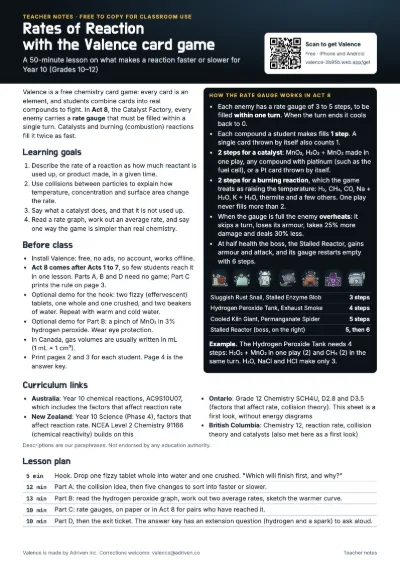
Rates of Reaction with the Valence card game
A lesson on what makes a reaction faster or slower, built around Act 8 of the game, where every enemy carries a rate gauge that students must fill within one turn, and catalysts and burning reactions count double.
- Teacher notes with learning goals, curriculum links (Australia, New Zealand, Ontario, BC) and a lesson plan
- Two student pages: explaining temperature, concentration, surface area and catalysts with particle collisions, reading a rate graph and working out average rates, Act 8 rate gauges, and where the game simplifies real chemistry
- Answer key, and a QR code students scan to install the game
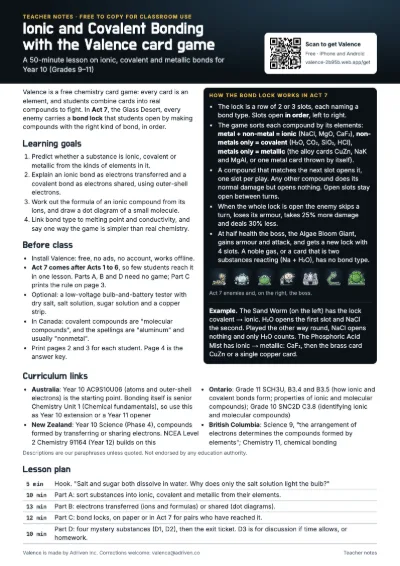
Ionic and Covalent Bonding with the Valence card game
A lesson on ionic, covalent and metallic bonding built around Act 7 of the game, where every enemy carries a bond lock that students open by making compounds with the right kind of bond, in order.
- Teacher notes with learning goals, curriculum links (Australia, New Zealand, Ontario, BC) and a lesson plan
- Two student pages: predicting bond type from the elements, ions and formulas, dot diagrams of small molecules, Act 7 bond locks, linking bonding to melting point and conductivity, and where the game simplifies real chemistry
- Answer key, and a QR code students scan to install the game
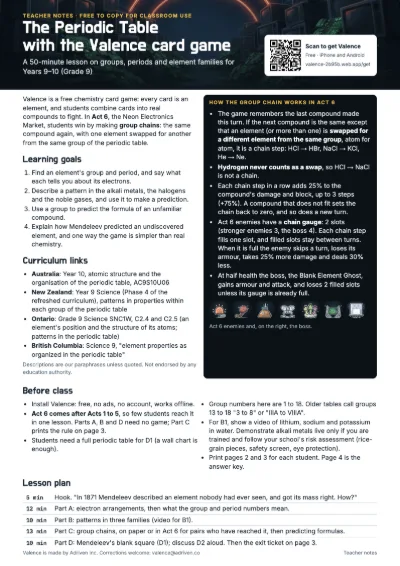
The Periodic Table with the Valence card game
A lesson on groups and periods of the periodic table built around Act 6 of the game, where swapping an element for another from the same group makes a chain that fills each enemy's gauge.
- Teacher notes with learning goals, curriculum links (Australia, New Zealand, Ontario, BC) and a lesson plan
- Two student pages: reading group and period from electron arrangements, the alkali metal, halogen and noble gas families, Act 6 group chains, predicting formulas, and Mendeleev's missing element
- Answer key, and a QR code students scan to install the game
All 8 worksheets: Valence worksheets. Free to copy for classroom use.
Using it in class
- Lesson starter (15 minutes). Students play the prologue and the first fights of Act 1. Then ask: which compounds did you make, and which elements did each one need?
- Before a new topic. Play the act that introduces it (for example Act 2 before acids and bases, Act 5 before precipitation). The game shows the rule in action; your lesson explains why it works.
- Revision. Set the quiz level to your class and let students work through their review notebook.
- Discussion. Why does an acid weaken a base-type enemy? Why does attacking with the same property make it stronger? Students can check their reasoning in the in-game codex, which fills in as they discover elements and compounds.
The game works offline, so it can be installed once and played without Wi-Fi.
See the game played: 82-second gameplay video on YouTube (neutralisation at 0:22, redox at 0:33, quiz at 0:59).
Step-by-step lesson plans: guides for teachers, starting with how to teach neutralisation with a game.
Student privacy and safety
- No sign-in needed. Progress stays on the device.
- Students under 14 play as guests. Sign-in is not available to them, and the app sends nothing to us from their devices.
- Students 14 or older may choose to sign in with Google or Apple to keep their progress across devices and join the leaderboards. Leaderboards show only a nickname made from a fixed word list (for example “Calm Neon 42”), never a real name, email or photo.
- For players 14 or older, the app sends play statistics and crash reports so we can fix problems. We do not collect advertising IDs and do not use the data for ads.
- No ads, no chat, no messaging between players, no purchases, no location.
Full details: privacy policy.
Common questions
- Is Valence free?
- Yes. Valence is free on Android and iPhone, with no ads, no in-app purchases and no chat.
- What grade levels is Valence for?
- Grades 7 to 12. The quiz has six levels: Grade 7, Grade 8, Grade 9, Grade 10, Chemistry I and Chemistry II, with 1,257 questions in total.
- What chemistry topics does Valence cover?
- Building compounds from elements, neutralization and pH, oxidation and reduction, electron shells, precipitation reactions, the periodic table, types of chemical bonds, reaction rate and catalysts, chemical equilibrium and nuclear reactions. Each of the ten acts adds one of these ideas.
- Do students need an account?
- No. Students can play without signing in and their progress stays on the device. Students under 14 cannot sign in, and the app sends nothing from their devices.
- Does Valence collect student data?
- Not from students under 14. For players 14 or older, the app sends play statistics and crash reports without advertising IDs, and sign-in is optional. Leaderboards show only a nickname made from a fixed word list.
- Does Valence work offline?
- Yes. After installing, students can play without Wi-Fi.
- Where is Valence available?
- Right now in Canada, Australia and New Zealand, in English, on Android (Google Play) and iPhone and iPad (App Store).
Feedback
We are a small team and we read every message. If you find a chemistry mistake, or try Valence with a class, please tell us what worked and what didn’t: valence@adriven.co